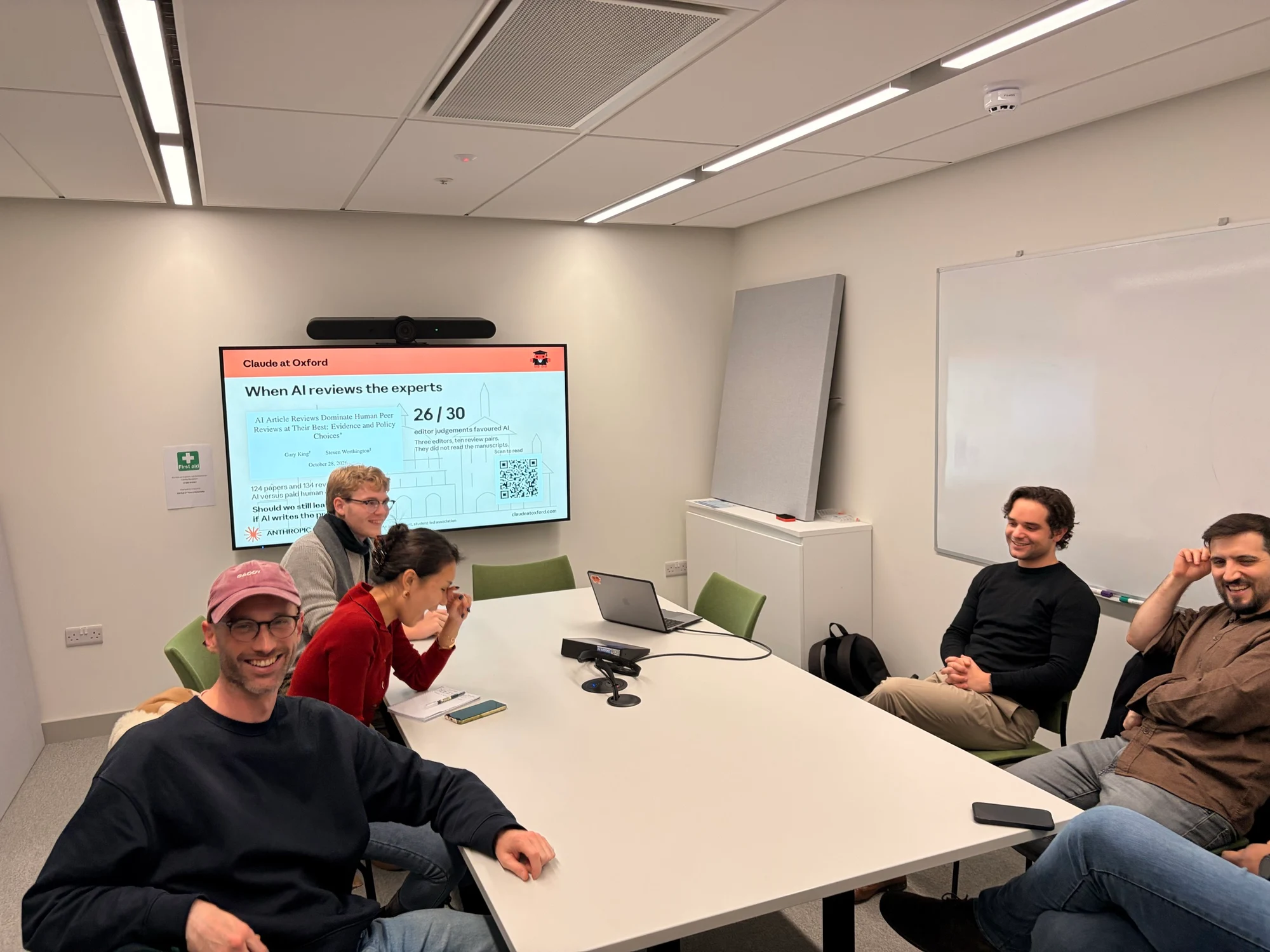
Eight students, different starting points
Our second Campus Discussion convened eight students with strong opinions from across undergraduate, graduate and DPhil tracks. Their disciplines ranged across History, Economics, Public Policy, Digital Education and Computer Science.
The focus was a question about education and human capability: when AI can perform a task, what reasons remain for learning to do it ourselves? We considered better results today alongside the effort, judgement and experience that might build expertise for tomorrow.
Three developments that brought the question into focus
We discussed the question in light of three research developments released in the fortnight before the meeting. Each offered a different challenge to familiar ideas about what human expertise requires.
28 OCTOBER 2026 · WORKING PAPER
AI Article Reviews Dominate Human Peer Reviews at Their Best ↗
Gary King and Steven Worthington compared AI-generated reviews with reviews by paid human experts across 124 papers and 134 review pairs. AI reviews performed better under their evaluation. Three former editors preferred AI in 26 of 30 judgements across ten pairs, but did not read the manuscripts. The study evaluates review quality, rather than demonstrating better publication decisions or greater improvements to revised papers.
Read the paper and appendix ↗2 NOVEMBER 2026 · EARLY RESEARCH BLOG
Sparks of Weight-Space Programming ↗
Rikiya Takehi and colleagues explored AI reading and directly editing another neural network’s internal numerical settings. In one demonstration, a targeted fix reduced repetitive reasoning and improved a small model’s maths score. A second model did not meaningfully improve. These early results raised a question for the discussion: if AI can help build or repair the tool, what must a person still understand to use it well?
Read the research blog ↗4 NOVEMBER 2026 · NATURE RESEARCH ARTICLE
An AI-native experimental laboratory for autonomous biomolecular operations ↗
Mingyu Wu and colleagues presented AutoDNA, a system in which AI agents coordinate laboratory instruments for specialised DNA experiments. Its demonstrations included a DNA storage workflow with more than 11,000 automated operations. People still maintained the hardware and replenished supplies. This moved the question from work on a screen to the practical experience through which scientists learn.
Read the AutoDNA paper ↗Related commentary: James Zou, AI agents enter the ‘wet lab’ ↗
WHERE WE FOUND COMMON GROUND
AI should complement the effort of learning
The room agreed that AI should support educational effort rather than become a substitute for it. The difficult question was what that principle should mean in practice.
Education for a world that keeps changing
Participants drew historical parallels with university mathematics entrance examinations. They argued that the growth of mathematical knowledge and the arrival of calculators had changed both the difficulty of exams and what we demand from mathematicians. The comparison prompted a broader question: when a tool removes one kind of difficulty, should education ask us to tackle something more demanding?
When someone asked why AI needed to enter education at all, the room converged on a response: leaving it out would risk preparing future generations for a world that no longer exists. That agreement coexisted with a commitment to preserving meaningful intellectual effort.
Peer review divided the room
The results of the peer-review study did not settle how participants felt about using AI in science. Many described a visceral discomfort with this particular shift, despite the strong results reported for AI-generated reviews.
One concern was epistemic regression towards the mean: a movement towards conventional or standardised ways of judging knowledge. Participants worried that models trained on existing work might produce feedback that was more generic and procedural than a human reviewer’s, potentially narrowing the range of ideas that science takes seriously. This was a concern raised in the room, rather than a finding established by the paper’s comparison.
The discussion also turned to the incentives behind scientific publishing. Could faster, cheaper reviews intensify the pressure to publish and produce papers at ever greater speed? AI might relieve unpaid, time-pressed reviewers of difficult and demanding work, while leaving untouched the structural question of why reviewers receive so little compensation within a large commercial publishing industry.
The disagreement therefore concerned more than whether a review was useful. It also concerned what kind of scientific community this change might create.
Who gets to learn in an automated lab?
AutoDNA prompted concern about junior laboratory technicians and scientists. If agents take over practical tasks, could they crowd out the hands-on opportunities through which newcomers become capable practitioners?
Others challenged the idea that this had to be a zero-sum choice. Automated laboratories could operate alongside laboratories that preserve practical training for junior scientists. Participants saw that possibility as contingent on institutions retaining the budget and incentives to provide those opportunities. Technical capability alone would not guarantee that training survived.
The case for keeping apparently obsolete skills
A contribution from Computer Science challenged the confidence with which we might declare any skill suitable for complete outsourcing. Butter churning offered an example: few of us might know how to do it, and machines have performed it for a long time, but does that establish that nobody ought to learn it manually?
The argument echoed Chesterton’s fence: before removing a practice, we should understand what it was doing for us. A skill might preserve forms of understanding, experience or resilience that become visible only after we lose them.
Automation will not arrive everywhere at once
An economic-historical perspective added a further complication: people will not experience the gains from automation evenly across the world.
Autonomous driving served as a hypothetical example. If some societies became so accustomed to autonomous vehicles that younger generations no longer learned to drive, what would happen when those people travelled somewhere where that infrastructure was unavailable? The scenario raised questions about dependence on local systems and whether unequal access to efficiency gains could deepen existing inequalities.
WHERE THE DISCUSSION LEFT US
No confident list of things we ought to stop learning
The room converged on the view that we could not identify, with complete confidence, a skill that people ought to stop learning simply because AI could perform it.
There was more divergence about how institutions and wider systems should respond. Participants differed over when an educational pursuit might become inefficient, lose its productive purpose, or continue primarily as a hobby, and what value it should retain in those circumstances.
The question we carried forward was how to prepare people for an AI-shaped world while protecting the opportunities through which they develop capability, independence and judgement.
Written by Harry Quantrill from his account of the session. This is a thematic summary, not a verbatim transcript, formal vote or representative survey of Oxford students. Historical comparisons and future scenarios describe arguments explored in the room. Individual contributions are not named.
THE CONVERSATION CONTINUES
What do you think?
Add a perspective, challenge a proposal or return to a question we left open. You don’t need to have attended.
Opening the discussion…